


Best Immigration Adviser in Barking & London: What to Look For
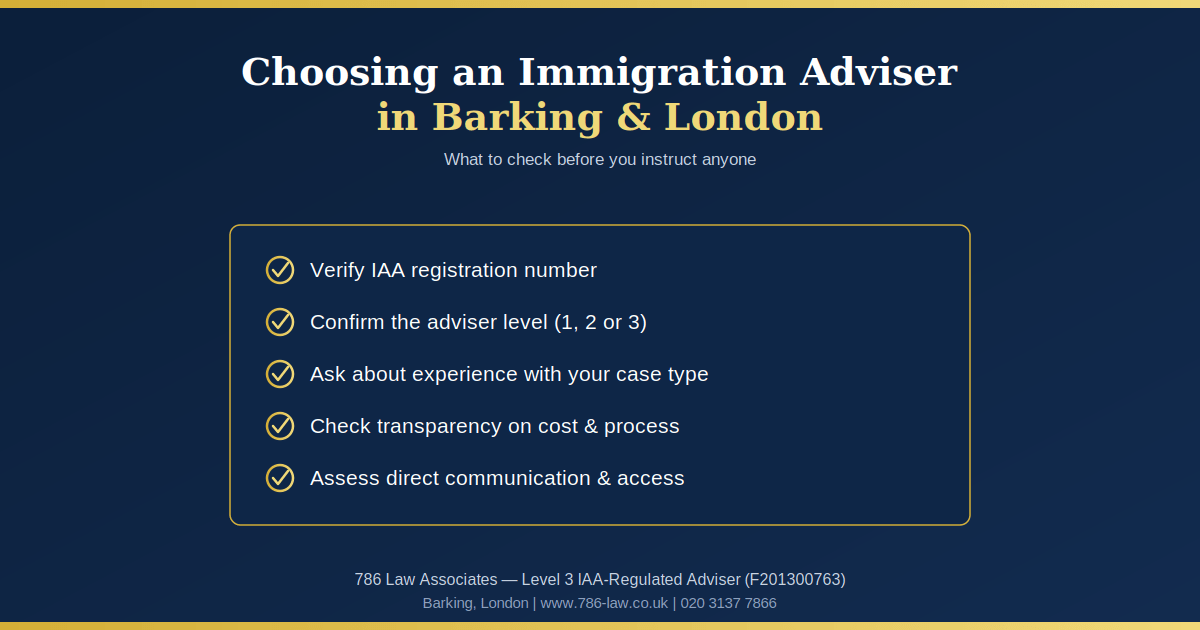
Searching for an “immigration adviser near me” in Barking or London brings up dozens of results — solicitors, consultants, agencies, and individuals offering advice at every price point. With immigration decisions affecting your right to live, work, or stay with family in the UK, choosing the wrong adviser isn’t just costly — it can be irreversible.
This guide explains exactly what to check before you commit to an immigration adviser in Barking, London, or anywhere in the UK.
1. Check Their Regulatory Status
This is the single most important check, and the one most people skip.
Anyone giving UK immigration advice must be regulated by law. The body responsible for regulating immigration advisers is the Immigration Advice Authority (IAA) — formerly the Office of the Immigration Services Commissioner (OISC).
It’s worth understanding this clearly: not every regulated immigration professional is a solicitor, and you don’t need a solicitor to get expert, fully authorised immigration advice. A Level 3 IAA-regulated immigration adviser is authorised to handle the same range of complex cases — including appeals, human rights claims, and Tribunal representation — as many solicitors, often at a more accessible cost.
If someone offers immigration advice without being IAA-regulated (or SRA-regulated, in the case of solicitors), it is a criminal offence for them to do so. Always ask for their registration number and verify it directly on the IAA public register — a legitimate adviser will have no issue providing this.
2. Understand the Adviser Levels
Not all regulated advisers can handle the same type of case. The IAA operates three levels:
- Level 1 — Basic casework: straightforward applications, no complex issues
- Level 2 — More complex casework, including some applications involving discretion
- Level 3 — The highest level, covering the most complex cases: appeals, human rights claims, asylum matters, and representation before the First-tier and Upper Tribunals
If your case involves a previous refusal, an appeal, a human rights claim, or anything outside a straightforward application, you need a Level 3-regulated adviser. A Level 1 or Level 2 adviser is not permitted to handle these matters — using one for a complex case can mean the advice you receive isn’t actually authorised for your situation.
3. Ask About Direct Experience With Cases Like Yours
Immigration law covers a huge range of case types — spouse visas, skilled worker sponsorship, asylum, appeals, sponsor licences, and more. An adviser who is excellent with straightforward visa extensions may have limited experience with contested appeals or human rights claims.
Before instructing anyone, ask:
- How many cases like mine have you handled?
- What’s your experience specifically with appeals or refusals (if relevant)?
- Do you have direct experience with the Home Office decision type I’ve received?
A good adviser will answer these questions specifically, not vaguely.
4. Look for Transparency Around Cost and Process
Reliable advisers are upfront about:
- Fixed fees vs. hourly rates
- What’s included in the price (and what isn’t)
- Realistic timescales for your case type
- Realistic chances of success — not just what you want to hear
Be cautious of anyone who guarantees a specific outcome. No regulated adviser can honestly promise a visa will be granted or an appeal will succeed — immigration decisions ultimately rest with the Home Office or a tribunal judge. What a good adviser can promise is that your case will be prepared to the highest possible standard.
5. Consider Accessibility and Communication
Immigration cases often involve urgent deadlines — a 14-day appeal window doesn’t wait for a slow response. When comparing advisers, consider:
- Will you speak directly to the person handling your case, or be passed between staff?
- What languages do they offer advice in? (This matters significantly in diverse communities like Barking, where English may not be a client’s first language)
- How quickly do they respond to enquiries?
A personalised service — where you consistently speak to the adviser actually working your case — tends to produce better outcomes than a high-volume model where cases are passed between multiple staff.
6. Local Knowledge, National and International Reach
If you’re based in Barking or East London, working with a local adviser has practical advantages — easier in-person meetings, familiarity with the local community, and accessibility. That said, immigration law is the same nationally, so the adviser’s expertise matters more than their exact postcode. Many reputable advisers based in London and Barking also support clients UK-wide and internationally through online consultations.
Red Flags to Watch For
- No verifiable IAA/OISC registration number
- Reluctance to confirm their adviser level
- Guarantees of success
- Pressure to pay large sums upfront before any advice is given
- Vague answers about experience with your specific case type
- No written client care letter or terms of engagement
What This Looks Like in Practice
786 Law Associates is based in Barking and has practised exclusively in UK immigration law since 2009. The practice is led by a Level 3 IAA-regulated immigration adviser (F201300763) — the highest level of regulation available to an immigration adviser — with particular experience in appeals, refusals, and human rights applications. 786 Law Associates is not a firm of solicitors and is not regulated by the SRA; advice and representation are provided under IAA regulation. Advice is available in English, Urdu, and Punjabi, and clients are supported both in person and through online consultations across the UK and internationally.
Whether you’re comparing advisers locally in Barking or looking more broadly across London, the checks above apply the same way: verify regulation, confirm the adviser level matches your case, and look for clear, honest communication from the start.
Final Thoughts
The right immigration adviser can be the difference between a smooth application and a costly refusal. Before instructing anyone, take the time to verify their regulatory status, confirm their level matches the complexity of your case, and ask direct questions about their experience. A few minutes of checking upfront can save months of delay — or worse, an outcome that can’t be undone.